


.svg)

Topics
See it in action
TL;DR
- Patient leakage is when patients fall out of your healthcare organization before completing care, including open referrals, no-shows, lapsed recalls, and unbooked follow-ups, and is more often the result of capacity constraints than patients losing interest.
- Research puts referral leakage at 30 to 50 percent of outpatient referrals, which adds up to six figures a year for a typical specialty practice before downstream procedures.
- The fix is proactive, two-way outreach that carries a conversation all the way to a booked appointment instead of one-way reminders.
- Start by baselining one leaky workflow, translating the leakage into dollars, and measuring recovered visits rather than messages sent.
Topics
TL;DR
- Patient leakage is when patients fall out of your healthcare organization before completing care, including open referrals, no-shows, lapsed recalls, and unbooked follow-ups, and is more often the result of capacity constraints than patients losing interest.
- Research puts referral leakage at 30 to 50 percent of outpatient referrals, which adds up to six figures a year for a typical specialty practice before downstream procedures.
- The fix is proactive, two-way outreach that carries a conversation all the way to a booked appointment instead of one-way reminders.
- Start by baselining one leaky workflow, translating the leakage into dollars, and measuring recovered visits rather than messages sent.
Healthcare organizations spend enormous energy measuring incoming demand: referrals received, new patient appointments, marketing performance, and physician outreach.
But there’s another kind of demand that most organizations never measure.
Recoverable demand is every patient who has already entered the care journey but has not yet it. That opportunity may be larger than most organizations realize.
Watch the full session:
For years, healthcare organizations and specialty groups treated access as a demand-generation problem. Health systems invested in physician liaisons, referral growth, digital scheduling, and marketing. Those investments paid off, and today many specialty groups and healthcare organizations are not short on demand. They’re short on capacity. Patients are already entering the system. The challenge is getting them all the way through their care.
The struggle now is because patients disappear after they've already entered the system. A referral lands in a queue and never becomes an appointment. A provider calls out, and a full day of patients has to be moved at once. Someone misses a visit and is never called again. A follow-up gets recommended and never booked. A patient due for annual care slips off the recall list.
Most organizations treat these as six separate operational headaches. They are not. They are a single problem: patient leakage.
Patient leakage is becoming one of the largest, and least measured, sources of delayed care, unused capacity, and lost revenue in specialty healthcare.
What Is Patient Leakage?
Patient leakage is the loss of patients who already intended to receive care and have not completed the journey. They reached you once, through a referral, a call, or a prior visit, and then dropped out somewhere between that first touch and care delivered. Unlike a patient who chose a competitor, a leaked patient still wants the appointment. No one had the capacity to reconnect them.
That distinction matters because it’s revenue and care quietly walking out the door, and most practices never see it leave.
We think healthcare needs a better way to measure patient access.
| Incoming demand | Recoverable demand |
|---|---|
| Patients entering your system for the first time, e.g., through referrals, marketing, physician outreach, or other acquisition channels. Measures “how many patients entered our system.” | Every patient who already intended to receive care but hasn't completed the journey. Measures “how many patients who wanted care actually received it.” |
Includes open referrals, recall patients, patients waiting to be rescheduled, no-shows, and follow-up appointments that haven't been booked.
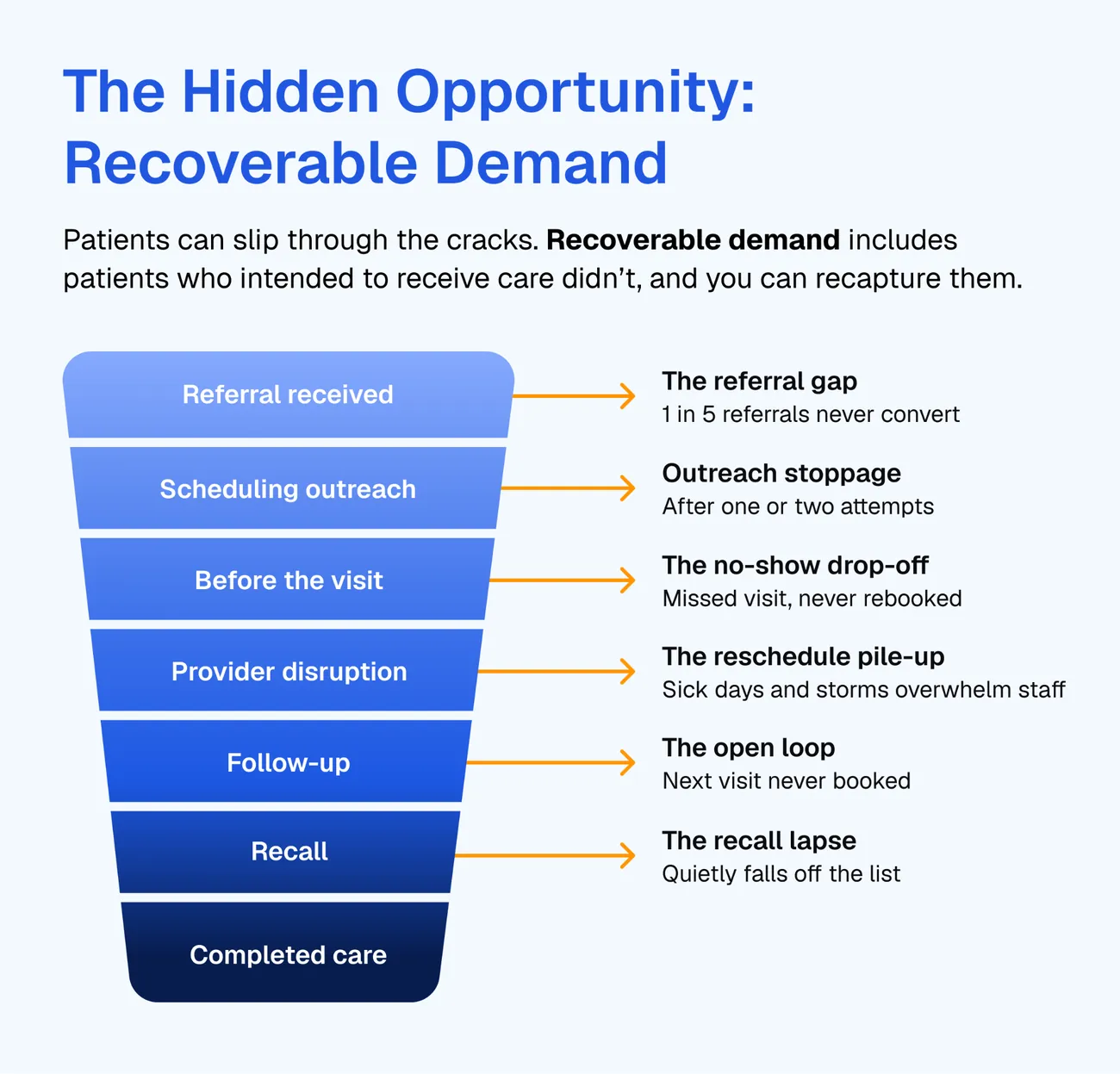
Where Do Specialty Practices Lose Patients?
Leakage is not random. It happens at the same handful of stages in almost every specialty, and each breakdown feeds the next.
Shift Your Focus From Activity to Outcome
Are you measuring incoming or recoverable demand?
| Incoming demand | Recoverable demand |
|---|---|
| A focus on traditional metrics | Gather leading metrics |
| Patients entering the system | Patients completing the journey |
| Marketing performance | Care conversion |
| Referral volume | Referral conversion |
Here are some examples you can map against your own data. Could you put a number on each of these today?
- A referral arrives and the patient never schedules.
- Scheduling outreach stops after one or two attempts.
- A confirmed patient no-shows and is never rebooked.
- A provider's sick day or a snowstorm creates a reschedule surge that overwhelms the front desk.
- A follow-up loop is left open.
- A recall patient lapses off the list for good.
Every organization in this space has leaks. The difference is most organizations either don't see it clearly or they're backfilling it with headcount, which is expensive and doesn't scale.

Sam Walters
Vice President of Operations, SENTA Partners
SENTA has invested heavily in automating referral conversion, recall outreach, no-show recovery, and other patient recovery workflows, not to reduce administrative work but because they’re seeking a competitive advantage.
Why Patient Leakage Happens: Capacity, Not Indifference
No one on your front-office team decided to stop calling patients. They answer phones, check patients in, coordinate referrals, field insurance questions, and absorb whatever the day throws at them. Working an aging referral, or calling the patient who missed last week, becomes tomorrow's task. Tomorrow becomes next week, and eventually the patient is gone.
Rescheduling is the clearest example, because it arrives in unpredictable bursts. One provider out sick can mean a full day of patients who all need to move at once, and you cannot keep a standing team idle waiting for a snowstorm.
Many of those patients weren't being reached consistently, and some of them never actually got rescheduled, creating gaps in care as well as missed revenue.

Dr. Parinita Amin
CEO, MDCS Dermatology
A dropped reschedule is often a patient who never comes back. The work is real, the intent is there, and it still falls through.
Quantifying Recoverable Demand
Let’s take a practice that receives 1,000 referrals a month. At 30 percent leakage and an average reimbursement of $250 per visit, that is 300 lost visits a month, 3,600 a year, and roughly $900,000 in annual revenue, before any of the procedures those visits would have generated.
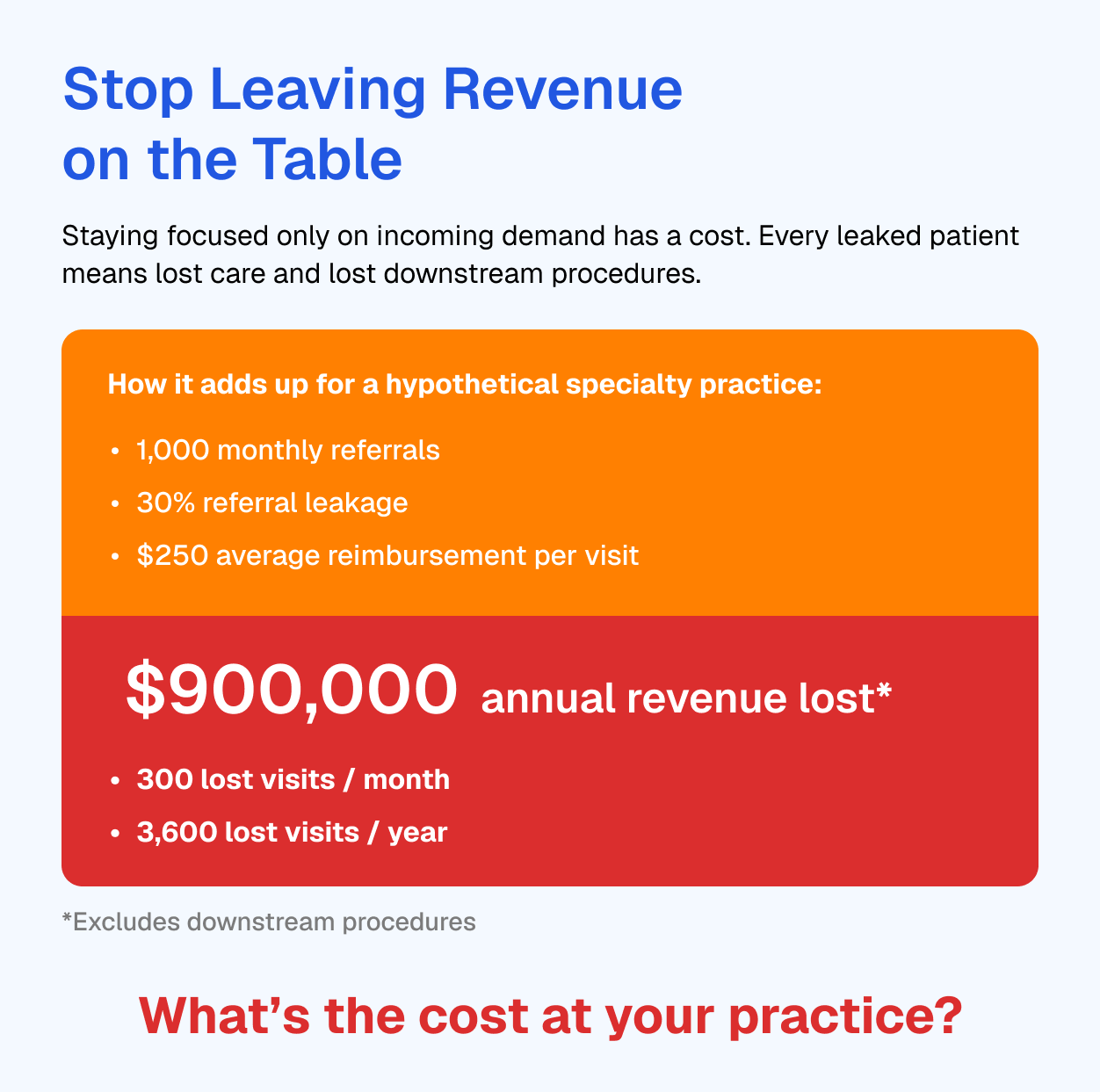
Leakage is well documented at the top of the funnel. According to a 12-year study, 30 to 50 percent of referrals are never completed, and a peer-reviewed study in the Annals of Family Medicine found roughly one in five specialty referrals went uncompleted within three months. The exact figure varies by specialty, but the direction is consistent. A meaningful share of the demand you already earned never converts.
The recovered number can be just as concrete. After automating referral outreach across three practices, SENTA Partners captured more than $1.3 million in additional annual appointment revenue and saved over 250 staff hours a month, having previously converted fewer than 70 percent of its referrals. Walters frames the work less as efficiency and more as what it takes for healthcare organizations to pull ahead.
Organizations that operationalize this first are going to have a structural advantage in patient capture that competitors just won't be able to close quickly. Human capital-dependent practices will always be one staffing shortage away from the funnel collapsing.
Sam Walters
Vice President of Operations, SENTA Partners

What Recovering Patients Actually Looks Like
The fix is not more reminders. Robocalls, mass texts, and one-way notifications announce something and then wait. They do not carry a conversation, follow up four times across phone and text, or book the appointment. That last mile is the entire job, and it is where agentic patient outreach does the work a stretched front desk cannot.
Rescheduling At Scale
At MDCS Dermatology, AI agents now run the reschedule and no-show campaigns that used to fall to whoever had a free afternoon. The practice has already rescheduled more than 2,600 appointments through rescheduling campaigns, all while holding patient satisfaction at 4.5 out of 5. The changes at MDCS aren’t limited to appointment volume. There’s a significant shift in their daily work. Instead of dialing a reschedule list, staff now spend their time with patients who need a person, including those who are feeling anxious or who have more complicated cases.
Activating Patients Who Are Overdue For Care
Annapolis Internal Medicine handed its flu-season outreach to an agent that booked the appointment inside the same call rather than asking patients to ring back. It auto-scheduled 61 percent of preventive visits and grew the team's effective capacity by 220 percent. This playbook can be repeated for patients who are overdue for hypertension and diabetes follow-up, and dramatically reduce care gaps.
---
Watch the clip: Dr. Titus Abraham of Annapolis Internal Medicine talks about getting proactive with preventive outreach.
Turning Disruption Into A Non-Event
Any time a snowstorm closed Boston Bone & Joint Institute, the old routine was a 6 a.m. cancellation call and a promise to rebook once the office reopened. They would have six staff members working the phones, and many patients never returned. After implementing agentic outreach, they were able to send closure notifications and rebooking requests together, automatically. Overnight, they say 53 percent of cancellations getting rescheduled before any staff arrived at the clinic.
---
Watch the clip: Katie Stoll, Director of Patient Access at Boston Bone & Joint Institute, shares her story about the New England snowstorm that “closed the office without a hiccup.”
Measure Recoverable Demand, Not Just Incoming Demand
The thread connecting all of it is a change in what you count. Most organizations measure incoming demand: referrals received, calls answered, and new-patient wait times. Far fewer measure recoverable demand, including referral conversion, recall completion, no-show recovery, follow-up completion, and patients successfully rescheduled.
| Incoming demand | Recoverable demand |
|---|---|
| What gets counted: activity | What gets counted: outcomes |
| Patients entering the system | Patients completing the journey |
| New patient inquiries | Completed-care rate |
| Referral volume | Referral conversion |
Leading practices and organizations measure the business outcome, not the activity. Treat recoverable demand more than another operational KPI. Instead, consider it a measure of how effectively an organization converts existing patient intent into completed care. Every recovered referral, completed recall, rebooked no-show, and scheduled follow-up increases access without generating a single new referral.
This is also why the work compounds. Once one workflow is connected to a shared record of each patient, the same engine runs across scheduling, reminders, reactivation, referrals, care gaps, and balances, and the patient never has to start their story over. For a deeper map of where the journey breaks, see the specialty patient journey and where access fails.
How To Start Recovering Patients This Quarter
Every health system knows how many referrals arrived last month. Far fewer know how much recoverable demand is already sitting inside their organization. That number deserves to be measured. Because the organizations that recover demand, not just generate it, will create better access, better utilization, and better financial performance.
You do not have to fix the whole funnel on Monday. Three steps make the case on their own:
- Baseline one leaky workflow. Pick the one you suspect bleeds the most, usually referrals, recall, or no-show rebooking. Most practices cannot state their referral conversion rate today, and that blind spot is step one.
- Translate the leakage into dollars. Monthly volume times leakage rate times reimbursement, before downstream procedures. Put a real number on it.
- Measure recovered visits, not AI activity. Watch the business metric move, and let the first win fund the next workflow.
"You have to start with knowing your referral conversion rate," Walters advised peers. Dr. Amin's rule was to start where the work is most painful and most repeatable, which for her was rescheduling. Reporting a referral conversion rate is a number that not all can currently do, but it’s often a high-volume, clear-pattern leak, and nailing that builds confidence for the next issue to tackle.
Frequently Asked Questions
What is patient leakage in healthcare?
Patient leakage is the loss of patients who already entered a practice's system and then dropped out before completing care. It includes unconverted referrals, no-shows who never rebook, lapsed recall patients, and follow-ups that are never scheduled.
How much revenue does patient leakage cost a specialty practice?
For a practice receiving 1,000 referrals a month at 30 percent leakage and $250 per visit, leakage represents about 3,600 lost visits and $900,000 a year, before downstream procedures. Research finds 30 to 50 percent of outpatient referrals are never completed.
What causes patients to fall out of the care journey?
Patients fall out of the care journey is caused by a lack of operational capacity, not patient intent. Front-office teams prioritize inbound work, so proactive outreach on referrals, recalls, and no-shows gets deferred until those patients are lost.
How can specialty practices recover lost patients?
By replacing one-way reminders with proactive, two-way outreach that follows up persistently across phone, text, and email and books the appointment directly. Start by baselining one workflow, quantifying the leakage, and tracking recovered visits.
---
The patients are already in your system. The demand was booked, referred, or recommended months ago. The only open question is whether anyone reaches them before it lapses, and that no longer has to depend on who had a free hour that afternoon.
See how Activate closes the gap, handling referrals, recalls, no-shows, and aging balances across phone, text, and email on one shared record of each patient.

Erin McInrue Savage
Head of Brand and Content
Erin McInrue Savage is the Head of Content at Assort Health, where she oversees brand, AEO, and editorial strategy.