
Building Healthcare That Remembers

Jeffery Liu

,

July 8, 2026

Healthcare's biggest challenge isn't staffing or AI. It's memory. Why the future of patient access depends on systems that remember context.

Patients are invisible in American healthcare today.

A patient calls to schedule an appointment and explains why she’s seeking care. She calls back the following week about a referral and explains it all again. She fills out an intake form with information she already shared. Every interaction starts over, as if the last one never happened. 

The problem isn't that providers don't care. It's that every step of the patient journey is often managed by a different system. One vendor handles scheduling, another reminders, another intake, another chat. The patient moves between them, but the context doesn't. Staff become the integration layer, piecing together conversations by hand while patients repeat themselves at every turn.

Healthcare organizations want to deliver a five-star patient experience. Instead, patient access teams spend hours reconstructing context instead of helping patients, and too many appointments never get booked simply because the system couldn't connect the dots.

For years, healthcare has treated access as a staffing problem. When demand increased, organizations hired more schedulers, expanded call centers, or added capacity. Yet despite decades of investment, patients still wait on hold, appointments go unfilled, and staff spend their days searching for information that already exists somewhere else.

If access were simply a staffing problem, we would have solved it by now.

Healthcare built systems to record information. It never built systems to remember context.

That's the deeper problem.

The Front Door Unlocks the Entire Patient Journey

When we started Assort, our goal wasn't to build an AI that could answer a phone call. We started with the front door because that’s where every patient journey begins. 

Anyone who has run a healthcare organization knows that first interaction matters. If a patient can't get through, gets routed incorrectly, or has a frustrating experience, they may never come back. But we believed something even more important was happening during that first conversation.

The front door is where healthcare creates context: why a patient is seeking care, what has already happened, what needs to happen next, which provider they're hoping to see, and the countless preferences and operational details that shape the rest of their journey.

We had one conviction early: if we earned the front door, we could earn the rest of the patient journey. The first conversation creates the context every interaction that follows depends on. If we could capture it once and carry it forward, every workflow becomes smarter instead of starting over: scheduling improves, referrals move faster, intake requires less repetition, follow-up becomes proactive instead of reactive. Rather than building disconnected products, we build a connected system where every interaction makes the next one better. 

A patient who prefers Spanish, morning appointments, and Dr. Galvez shouldn't have to repeat those preferences to a referral coordinator, re-enter them on an intake form, or explain them again when she receives a reminder. 

That also means organizations don't have to start over. They can begin with one workflow, prove ROI, then expand across the patient journey without rebuilding context every time. 

Phase one was earning the front door. It took months to build a single agent because every practice is different and every rule had to be learned by hand. 

The hard part wasn’t teaching AI how to hold a conversation. It was teaching AI the operational knowledge that makes healthcare work: scheduling protocols, provider preferences, insurance rules, referral pathways, and countless edge cases that exist nowhere except in the experience of front-office teams.

Building our first agents meant encoding healthcare one workflow at a time. Every exception made the platform smarter. Over time, we realized we weren't just automating conversations; we were building a system that could learn how healthcare operates.

Phase two is carrying that context across the patient journey. Looking back, scheduling wasn’t the destination. It was the foundation.

Teaching AI Agents How Healthcare Works

Healthcare doesn’t simply run on software. It runs on operational knowledge: thousands of protocols, routing rules, scheduling exceptions, insurance nuances, and provider preferences that determine how care gets delivered.

Some live in “the binder” behind the front desk. Some live in shared folders, spreadsheets, or sticky notes stuck to monitors. Others exist only in the heads of experienced front-office teams.

Patients never see that operating system, but they feel it every day. 

Those rules, exceptions, and workflows determine whether patients receive the right care at the right time and successfully complete their journey. Those aren’t edge cases. They are the real operating layer of healthcare.

Patients never see these artifacts, but they shape nearly every care journey. When that knowledge is fragmented, patients feel it in every call, form, and follow-up.

Teaching AI the operational complexity of healthcare is what allows organizations to automate more complex workflows while reducing manual work, improving patient access, and maintaining accuracy.

Over time, we realized we weren’t building one kind of intelligence. We were building two, and every patient interaction strengthens both proprietary datasets.

Two Datasets That Learn Together

The first is operational intelligence: how healthcare actually operates. Every specialty, every organization, and often every provider has distinct protocols, routing rules, scheduling logic, referral requirements, insurance nuances, and operational exceptions that determine what should happen. These are the thousands of decisions that determine whether a patient ultimately reaches the right care.

The second is patient intelligence: how patients actually seek care, what they’re trying to accomplish in an interaction, and the context they reveal along the way. Patients don’t know the internal workflow. They describe symptoms, uncertainty, language, urgency, and what has already happened—all in their own words across voice, chat, text, forms, and every other channel. They don’t call asking for an “orthopedic consultation." They say, “my knee’s been bothering me since pickleball.” 

A perfect conversation that doesn’t understand specialty workflows still sends patients down the wrong path. Perfect operational rules don’t help if the system can’t understand what the patient is really asking for. Only together can AI understand both a patient’s intent and healthcare’s complexity.

Every Interaction Makes the Platform Better 

Most software gets installed. Learning systems get smarter. 

Today, Assort has supported more than 190 million patient voice interactions, each teaching another way patients describe symptoms, another referral requirement, another insurance exception, or another specialty workflow.

Those interactions continuously improve the platform itself. Patient interactions deepen our understanding of how people navigate care, while deployments uncover new specialty workflows, edge cases, and care protocols that improve our evaluation systems, implementation tooling, and every future AI agent. 

The result is a learning flywheel: every deployment makes the platform smarter, every patient interaction makes it more personalized, and together they create an advantage that's difficult to replicate.

That's why we built Synapse on those two proprietary datasets. Rather than starting every implementation from zero, Synapse models specialty workflows, generates likely edge cases, and evaluates them before deployment. Every new deployment benefits from everything the platform has already learned while continuing to make it smarter. 

What once took months now takes weeks, even for some of healthcare's most complex specialty workflows.
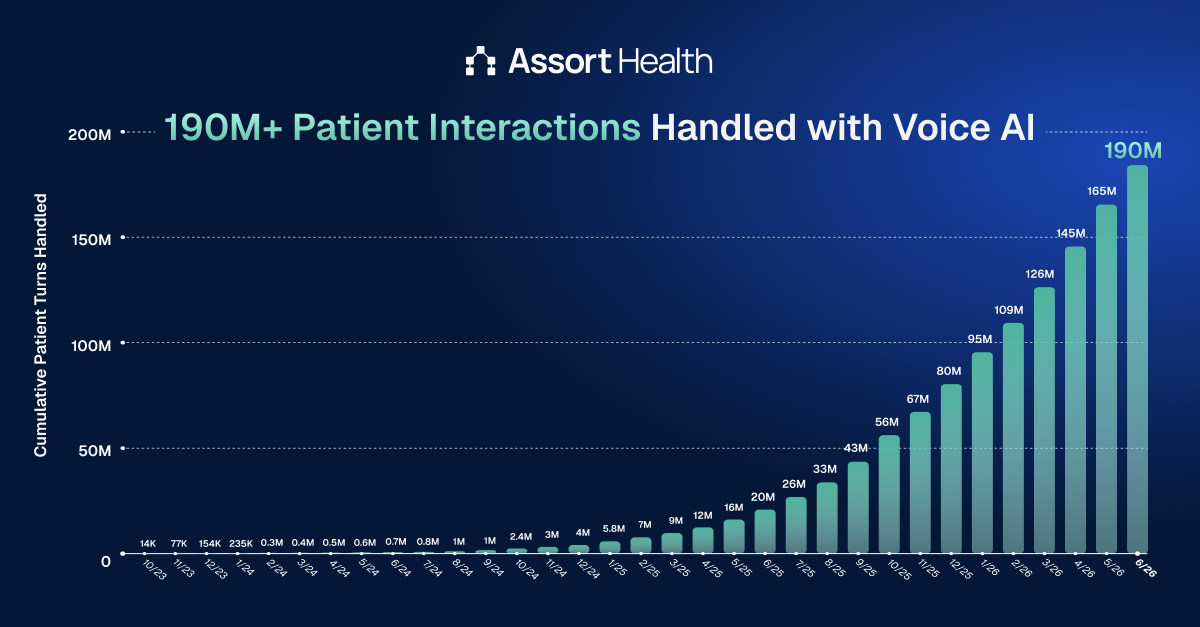
More than 190 million voice AI patient interactions have trained Synapse, the proprietary model behind Assort.

We don't think the future of healthcare AI is a collection of disconnected point solutions. It's healthcare that remembers. Customers shouldn’t have to choose between solving today’s operational problems and building for tomorrow. They can reduce call abandonment, speed referrals, simplify intake, and improve patient access today, while building the shared memory that makes every future workflow smarter. 

Building Healthcare That Remembers 

We call the technology that makes this possible Patient Journey Memory: a system that remembers what happened before, understands what should happen next, and carries context across every patient interaction. 

Healthcare that remembers changes three things:

  • Patients stop starting over. Every patient gets a personalized agent that remembers their language, channel, timing, and provider preferences across every interaction. Call back two weeks later and the system already knows.
  • Organizations stop reacting to what's already happened. The system detects changes in a patient’s journey as they happen—a flagged lab, a missed follow-up, a referral stuck in limbo—and acts on them the moment they appear instead of waiting for someone to notice.
  • Every workflow becomes connected. Intake forms autofill from what the system already knows. Provider triage rules apply automatically. An inbound call for one thing becomes the moment to close another: a patient calling to refill a prescription finds out, on the same call, that she’s due for a mammogram, and gets it scheduled before she hangs up.

That's what powers Continuous Patient Conversations: every channel operating on one shared patient context instead of disconnected systems.

Healthcare has spent decades building systems of record. We believe the next decade will be about building systems of memory. Just as every major computing platform eventually became a system that accumulated knowledge, we believe healthcare is entering the same transition. The organizations that improve fastest won’t simply automate workflows; they’ll build systems that remember.

We don't believe AI will remain confined to answering calls or automating individual workflows. We believe every patient will eventually have a continuous AI companion that understands their history, guides them through uncertainty, and helps coordinate every step of their care journey. Healthcare that remembers is how we get there.

That's why we recently announced a $120 million Series C. This investment isn't simply about growing Assort. It's about accelerating the infrastructure required to help healthcare remember across every patient interaction: not just the first phone call, but every referral, form, appointment, outreach, and payment that follows.

We're grateful for the trust our customers, employees, and investors have placed in us. But funding rounds are milestones, not destinations.

The work ahead remains the same as it was on day one.

Nobody should have to tell their story three times.

Nobody should wait on hold wondering if anyone is coming.

Nobody should fall through the cracks simply because the system forgot.

Healthcare should remember.

Jeffery Liu
Jon Wang
Latest blogs

Latest Blogs

Building Healthcare That Remembers

Jeffery Liu

Jon Wang

July 8, 2026

Patients are invisible in American healthcare today.

A patient calls to schedule an appointment and explains why she’s seeking care. She calls back the following week about a referral and explains it all again. She fills out an intake form with information she already shared. Every interaction starts over, as if the last one never happened. 

The problem isn't that providers don't care. It's that every step of the patient journey is often managed by a different system. One vendor handles scheduling, another reminders, another intake, another chat. The patient moves between them, but the context doesn't. Staff become the integration layer, piecing together conversations by hand while patients repeat themselves at every turn.

Healthcare organizations want to deliver a five-star patient experience. Instead, patient access teams spend hours reconstructing context instead of helping patients, and too many appointments never get booked simply because the system couldn't connect the dots.

For years, healthcare has treated access as a staffing problem. When demand increased, organizations hired more schedulers, expanded call centers, or added capacity. Yet despite decades of investment, patients still wait on hold, appointments go unfilled, and staff spend their days searching for information that already exists somewhere else.

If access were simply a staffing problem, we would have solved it by now.

Healthcare built systems to record information. It never built systems to remember context.

That's the deeper problem.

The Front Door Unlocks the Entire Patient Journey

When we started Assort, our goal wasn't to build an AI that could answer a phone call. We started with the front door because that’s where every patient journey begins. 

Anyone who has run a healthcare organization knows that first interaction matters. If a patient can't get through, gets routed incorrectly, or has a frustrating experience, they may never come back. But we believed something even more important was happening during that first conversation.

The front door is where healthcare creates context: why a patient is seeking care, what has already happened, what needs to happen next, which provider they're hoping to see, and the countless preferences and operational details that shape the rest of their journey.

We had one conviction early: if we earned the front door, we could earn the rest of the patient journey. The first conversation creates the context every interaction that follows depends on. If we could capture it once and carry it forward, every workflow becomes smarter instead of starting over: scheduling improves, referrals move faster, intake requires less repetition, follow-up becomes proactive instead of reactive. Rather than building disconnected products, we build a connected system where every interaction makes the next one better. 

A patient who prefers Spanish, morning appointments, and Dr. Galvez shouldn't have to repeat those preferences to a referral coordinator, re-enter them on an intake form, or explain them again when she receives a reminder. 

That also means organizations don't have to start over. They can begin with one workflow, prove ROI, then expand across the patient journey without rebuilding context every time. 

Phase one was earning the front door. It took months to build a single agent because every practice is different and every rule had to be learned by hand. 

The hard part wasn’t teaching AI how to hold a conversation. It was teaching AI the operational knowledge that makes healthcare work: scheduling protocols, provider preferences, insurance rules, referral pathways, and countless edge cases that exist nowhere except in the experience of front-office teams.

Building our first agents meant encoding healthcare one workflow at a time. Every exception made the platform smarter. Over time, we realized we weren't just automating conversations; we were building a system that could learn how healthcare operates.

Phase two is carrying that context across the patient journey. Looking back, scheduling wasn’t the destination. It was the foundation.

Teaching AI Agents How Healthcare Works

Healthcare doesn’t simply run on software. It runs on operational knowledge: thousands of protocols, routing rules, scheduling exceptions, insurance nuances, and provider preferences that determine how care gets delivered.

Some live in “the binder” behind the front desk. Some live in shared folders, spreadsheets, or sticky notes stuck to monitors. Others exist only in the heads of experienced front-office teams.

Patients never see that operating system, but they feel it every day. 

Those rules, exceptions, and workflows determine whether patients receive the right care at the right time and successfully complete their journey. Those aren’t edge cases. They are the real operating layer of healthcare.

Patients never see these artifacts, but they shape nearly every care journey. When that knowledge is fragmented, patients feel it in every call, form, and follow-up.

Teaching AI the operational complexity of healthcare is what allows organizations to automate more complex workflows while reducing manual work, improving patient access, and maintaining accuracy.

Over time, we realized we weren’t building one kind of intelligence. We were building two, and every patient interaction strengthens both proprietary datasets.

Two Datasets That Learn Together

The first is operational intelligence: how healthcare actually operates. Every specialty, every organization, and often every provider has distinct protocols, routing rules, scheduling logic, referral requirements, insurance nuances, and operational exceptions that determine what should happen. These are the thousands of decisions that determine whether a patient ultimately reaches the right care.

The second is patient intelligence: how patients actually seek care, what they’re trying to accomplish in an interaction, and the context they reveal along the way. Patients don’t know the internal workflow. They describe symptoms, uncertainty, language, urgency, and what has already happened—all in their own words across voice, chat, text, forms, and every other channel. They don’t call asking for an “orthopedic consultation." They say, “my knee’s been bothering me since pickleball.” 

A perfect conversation that doesn’t understand specialty workflows still sends patients down the wrong path. Perfect operational rules don’t help if the system can’t understand what the patient is really asking for. Only together can AI understand both a patient’s intent and healthcare’s complexity.

Every Interaction Makes the Platform Better 

Most software gets installed. Learning systems get smarter. 

Today, Assort has supported more than 190 million patient voice interactions, each teaching another way patients describe symptoms, another referral requirement, another insurance exception, or another specialty workflow.

Those interactions continuously improve the platform itself. Patient interactions deepen our understanding of how people navigate care, while deployments uncover new specialty workflows, edge cases, and care protocols that improve our evaluation systems, implementation tooling, and every future AI agent. 

The result is a learning flywheel: every deployment makes the platform smarter, every patient interaction makes it more personalized, and together they create an advantage that's difficult to replicate.

That's why we built Synapse on those two proprietary datasets. Rather than starting every implementation from zero, Synapse models specialty workflows, generates likely edge cases, and evaluates them before deployment. Every new deployment benefits from everything the platform has already learned while continuing to make it smarter. 

What once took months now takes weeks, even for some of healthcare's most complex specialty workflows.

More than 190 million voice AI patient interactions have trained Synapse, the proprietary model behind Assort.

We don't think the future of healthcare AI is a collection of disconnected point solutions. It's healthcare that remembers. Customers shouldn’t have to choose between solving today’s operational problems and building for tomorrow. They can reduce call abandonment, speed referrals, simplify intake, and improve patient access today, while building the shared memory that makes every future workflow smarter. 

Building Healthcare That Remembers 

We call the technology that makes this possible Patient Journey Memory: a system that remembers what happened before, understands what should happen next, and carries context across every patient interaction. 

Healthcare that remembers changes three things:

  • Patients stop starting over. Every patient gets a personalized agent that remembers their language, channel, timing, and provider preferences across every interaction. Call back two weeks later and the system already knows.
  • Organizations stop reacting to what's already happened. The system detects changes in a patient’s journey as they happen—a flagged lab, a missed follow-up, a referral stuck in limbo—and acts on them the moment they appear instead of waiting for someone to notice.
  • Every workflow becomes connected. Intake forms autofill from what the system already knows. Provider triage rules apply automatically. An inbound call for one thing becomes the moment to close another: a patient calling to refill a prescription finds out, on the same call, that she’s due for a mammogram, and gets it scheduled before she hangs up.

That's what powers Continuous Patient Conversations: every channel operating on one shared patient context instead of disconnected systems.

Healthcare has spent decades building systems of record. We believe the next decade will be about building systems of memory. Just as every major computing platform eventually became a system that accumulated knowledge, we believe healthcare is entering the same transition. The organizations that improve fastest won’t simply automate workflows; they’ll build systems that remember.

We don't believe AI will remain confined to answering calls or automating individual workflows. We believe every patient will eventually have a continuous AI companion that understands their history, guides them through uncertainty, and helps coordinate every step of their care journey. Healthcare that remembers is how we get there.

That's why we recently announced a $120 million Series C. This investment isn't simply about growing Assort. It's about accelerating the infrastructure required to help healthcare remember across every patient interaction: not just the first phone call, but every referral, form, appointment, outreach, and payment that follows.

We're grateful for the trust our customers, employees, and investors have placed in us. But funding rounds are milestones, not destinations.

The work ahead remains the same as it was on day one.

Nobody should have to tell their story three times.

Nobody should wait on hold wondering if anyone is coming.

Nobody should fall through the cracks simply because the system forgot.

Healthcare should remember.

Jeffery Liu

Jon Wang

Latest Blogs