

.svg)

Topics
See it in action
TL;DR
- Every unanswered inbound call is a patient who couldn't get scheduled. Automating high-volume, routine call types recovers those patients without adding labor capacity.
- The sequence that works starts with a call workflow audit, moves to the highest-volume call types, integrates deeply with your EHR, configures and tests before launch, then measures and expands. Skipping the phased approach or settling for read-only EHR integration is where most deployments fail.
- Emergencies and crisis situations must route to staff with full context, as must complex clinical conversations. Automation should resolve the request end-to-end.
Topics
TL;DR
- Every unanswered inbound call is a patient who couldn't get scheduled. Automating high-volume, routine call types recovers those patients without adding labor capacity.
- The sequence that works starts with a call workflow audit, moves to the highest-volume call types, integrates deeply with your EHR, configures and tests before launch, then measures and expands. Skipping the phased approach or settling for read-only EHR integration is where most deployments fail.
- Emergencies and crisis situations must route to staff with full context, as must complex clinical conversations. Automation should resolve the request end-to-end.
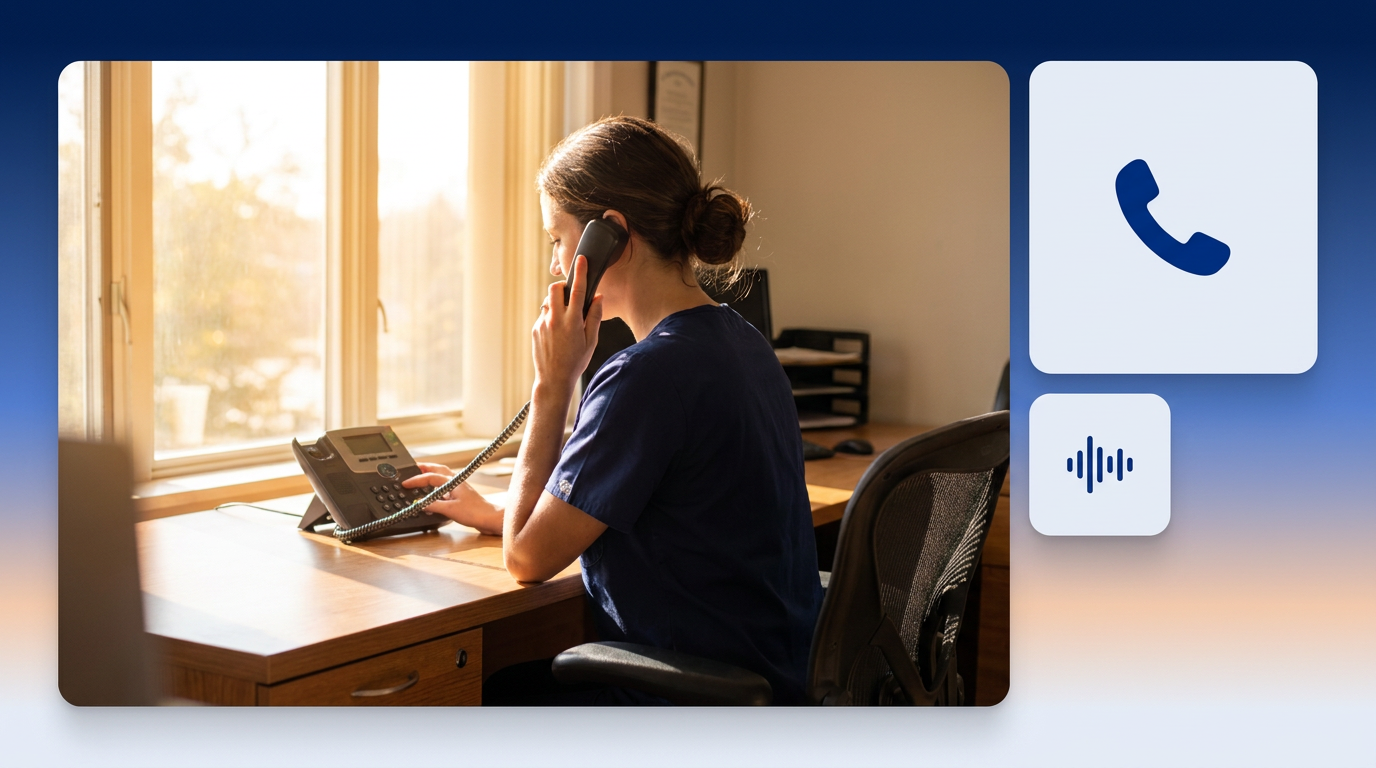
Patient access teams are being asked to handle more calls with fewer experienced schedulers. When patients wait too long, they abandon the queue, book elsewhere, or delay care. Hiring helps, but it rarely fixes the core problem: new schedulers need time to learn provider rules, insurance requirements, and triage workflows, while turnover keeps resetting that progress.
Phone automation can help, but only when it completes routine work inside the EHR instead of creating another callback queue. The rollout has to start with the right call types and enough EHR depth to finish the work, not just capture a message for staff to clean up later.
Which Call Types Belong in Automation First
Staff recover the most time when routine, rules-driven calls resolve without a warm handoff. Start with the call categories that fill the queue before lunch and rarely need clinical judgment.
- Scheduling and rescheduling requests, plus cancellations, require deep EHR write-back: open slots, moved visits, and cancellations all have to land in the EHR so staff isn't re-keying completed calls.
- Appointment reminders and confirmations let patients confirm, cancel, or reschedule in the same interaction, which can reduce no-shows.
- Prescription refill requests and intake calls let the caller give information once; Concierge captures insurance verification details over the phone, verifies eligibility in real time, and writes the result into the EHR, while Orchestrate handles intake forms, automated fax and referral processing, and EHR-native task creation.
- Referrals and billing questions can be routed without pulling a scheduler off a harder call, while FAQs are resolved directly.
- After-hours calls capture overnight and weekend demand when many practices have limited after-hours staffing; Concierge extends that coverage across 29 languages.
Routine calls shouldn't turn into messages that staff rework later. Staff recover capacity when automation answers the call and writes the result back without waiting for a scheduler.
When a practice needs routine calls answered before patients abandon the queue, Concierge schedules, triages, captures insurance, and queues EHR tasks 24/7, and handles multi-request calls (a refill, a schedule change, and a provider question) in a single interaction so patients don't call back. Hold-time gains only last when the automation boundary is clear.
What Stays With Your Staff, and Why
Emergencies and crisis situations sit outside that boundary, as do complex clinical conversations, and must always route to a person. Automation that tries to handle these creates the kind of adverse-event risk no practice leader wants to defend.
Keep red-flag symptoms and acute behavioral health crises out of automation. The Substance Abuse and Mental Health Services Administration's (SAMHSA) crisis care guidelines are direct: a mental health crisis is a human experience AI cannot possess. Sensitive decisions and diagnostic uncertainty belong with clinicians.
Routine-looking clinical details need the same escalation discipline. When a caller mentions details that change the risk profile (a knee-pain caller who also reports new chest symptoms, or a post-op patient describing floaters and dizziness), Concierge treats the symptoms as an escalation trigger rather than a standard scheduling path.
Warm Handoff passes full call context to staff, including patient identity, complaint details, insurance verification status, triage notes, and emotion signals, so the patient never repeats their story. Track escalation and error rates alongside containment, because a safe rollout depends on proving that red-flag calls leave automation with context.
Deploy Phone Automation in Five Steps, Not All at Once
Safe warm handoffs depend on rollout sequence. Launch in phases to reduce workflow risk, preserve the baseline for ROI, and keep error-prone workflows out of the live queue until easier ones hold.
1. Audit Your Current Call Workflows
Prove access gains by measuring where time and demand disappear today. Before launch, establish baselines for your most common call intents, current cost per call, average handle time, no-show rate, and patient satisfaction.
2. Prioritize the Highest-Impact Call Types
Return staff capacity fastest by choosing a first workflow that is frequent and low risk. Start with calls your schedulers handle all day. The CAQH Index shows how much time providers still spend on manual prior authorization and eligibility work, and specialty scheduling creates the same phone pressure. Automate high-volume, non-urgent calls first, then widen scope after the model holds.
3. Integrate AI With Your EHR and Scheduling Systems
Staff lose the time savings when automation can't finish the workflow. If a scheduler has to re-key the appointment after the call, the queue still owns the work. In Epic and athenahealth environments, the operational win is completed calls that don't become staff cleanup. Cerner sites need the same completed-call workflow: Assort Health delivers bidirectional, real-time integration with 20+ EHR/PMS systems, connecting live provider availability with confirmed appointment write-back, provider-specific scheduling rule enforcement, and automatic patient record updates.
Specialty scheduling stalls unless every prerequisite is verified up front: availability, insurance or referral requirements, and slot write-back all have to clear before the booking lands. Concierge validates prior authorization and referral requirements before final booking, so issues surface before the patient has scheduled or arrived.
4. Configure, Test, and Launch AI Workflows
Specialty logic has to be encoded before go-live so scheduling errors don't reach the live queue. The wrong visit type creates scheduling risk and sends the call back to patient access. Synapse, Assort's automated implementation engine, combines the practice's raw data with a proprietary dataset of 190M+ patient interactions to build organization-specific workflows from day one. Assort's implementation team maps appointment types, provider preferences, routing logic, and new versus existing patient and insurance-specific logic, so those errors don't reach the live queue. This is why a typical Assort go-live occurs in a few weeks.
Compliance testing belongs in the same go-live work. HIPAA readiness covers architecture and vendor agreements for any component that touches PHI, along with HIPAA Security Rule safeguards for encryption, audit logging, and access controls.
5. Measure Outcomes and Expand Automation
Expand only after the first workflow holds its numbers against the baseline. The weekly dashboard tracks abandonment and average speed to answer, then ties both to end-to-end resolution. Treat every warm handoff as a protocol gap to close. Once one inbound call type holds its numbers, expand: Activate outbound campaigns turn the same automation toward care gap closure, inactive patient reactivation, Healthcare Effectiveness Data and Information Set (HEDIS) and Risk Adjustment Factor (RAF) optimization, no-show rescheduling, and payment resolution outreach. The same workflow supports seasonal vaccination.
The Mistakes That Sink Phone Automation
The phased rollout turns into lasting performance only when leaders control scope, integration depth, warm handoff quality, and analytics review. Four failure modes recur across deployments:
- Turning everything on from day one. Full automation on day one puts your hardest workflows live before the easy ones are proven. Pick one call type that can prove hold-time movement while humans keep answering calls that require staff judgment.
- Settling for a read-only EHR connection. If the integration can't write appointments back, it is message-taking dressed as automation. Insist on bidirectional write-back so completed calls stop landing in the staff cleanup queue.
- Handing off medical decisions without context. Clinical judgment belongs with a person, and the full call context has to move with the patient. Warm Handoff passes identity, complaint details, insurance verification status, triage notes, and emotion signals so staff never restart the conversation.
- Ignoring resolution and handoff analytics. Unwatched trends become provider-level complaints. Assort's platform surfaces scheduling accuracy and protocol adherence drift by provider and location, and flags optimization opportunities without manual reporting runs. Continuous automated QA runs alongside it: AI agents call and test deployed agents against benchmarks derived from 190M+ patient interactions, auto-suggest fixes, and support A/B testing of agent configurations.
The Metrics That Separate Resolution From Deflection
Automation works when patients complete the request. Measure resolution over deflection, and tie every number to the baseline across access, capacity, growth, and safety.
Access breaks before patients reach staff through call abandonment, average speed to answer, hold time, and patient satisfaction. Staff capacity changes when routine work resolves, as shown by containment rate, handoffs per call, and average handle time. Growth shows up when demand stays in the scheduling path through appointments booked and conversion rate, with no-show reduction showing whether booked demand turns into kept visits. Safety holds when protocols route correctly, measured by handoff rate, error rate, and scheduling accuracy.
Use Case: Cutting Hold Times Without Losing Patients to Abandonment
Hold time and abandonment move together, and neither number tells the full story on its own. A faster answer only matters if patients stay on the line long enough to get it, and a lower abandonment rate only matters if the calls that stayed produced a booked appointment. Read both against the same baseline.
Chesapeake Health Care cut hold times by 89%, down to roughly 45 seconds. Patients reached an answer before the queue pressure ever built, and staff stopped absorbing the frustration that used to arrive with each pickup.
TidalHealth Orthopedics paired that same access gain with a 75% drop in abandoned calls, so the demand that came in stayed inside the scheduling path instead of disappearing before the practice could respond. Faster pickup plus fewer walk-offs is the combination that turns a hold-time win into recovered access.
Why AI Voice Agents Beat the Phone Tree You Already Have
Phone trees break down when one caller needs a refill question answered before changing a schedule, then needs a provider-specific answer on top of that. The patient repeats the story after a handoff, and the scheduler starts from scratch.
Concierge handles that mixed-intent call differently: an AI voice agent can complete the routine pieces and send staff the full context when a warm handoff is needed.
Specialty calls often require appointment sequencing that a menu can't represent. When an ENT caller needs an ear-pain visit and a hearing aid check, Concierge sequences the ENT doctor and audiologist appointments in the correct clinical order. Assort's Patient Journey Memory carries context across every touchpoint, so patients never repeat their story. That depth comes from a proprietary dataset of 62K care protocols and 1.6M unique decision pathways across 22+ specialties.
Automate Patient Phone Calls Where Access Breaks
Performance in the live queue depends on the agent learning each practice's local logic without a months-long rebuild. Provider preferences, scheduling rules, insurance nuances, and clinical triage logic all vary by location, and the underlying workflow materials (SOPs, decision trees, EHR scheduling templates, call recordings) change with them.
For teams facing worse margins per FTE and rising call demand, Assort Health turns routine phone volume into a scalable access layer rather than another staffing problem. Book a demo with Assort Health to see Synapse turn your workflows into patient access automation.
Frequently Asked Questions
Can AI actually book appointments, or does it just take messages?
A real AI voice agent completes the booking end-to-end: it applies the practice's scheduling rules, confirms availability, verifies insurance, and writes the appointment back into the EHR. A system that only captures a callback request and drops it in a staff queue is message-taking, not automation. Concierge finishes the routine call in one interaction and hands off with full context when clinical judgment is required.
What kinds of patient calls should stay with human staff?
Emergencies, acute behavioral health situations, and clinical conversations that require diagnostic judgment always route to a person. Sensitive symptom reports and any red-flag details a caller mentions mid-conversation should also escalate. Concierge treats those signals as escalation triggers and passes complaint details, insurance status, triage notes, and emotion signals to staff so the patient never restarts the story.
How do AI voice agents handle specialty scheduling rules?
Specialty scheduling only works when the agent applies each provider's rules, insurance-specific logic, referral requirements, and clinical sequencing. Concierge is trained on a proprietary dataset of specialty protocols and decision pathways across 22+ specialties, so it can sequence linked appointments (ENT then audiology, for example) and validate prior authorization before a booking is confirmed.
Is patient-facing voice AI HIPAA-compliant?
Patient-facing voice AI is HIPAA-compliant when every component that touches PHI meets HIPAA obligations. Compliant vendors sign BAAs, disclose every subprocessor that touches PHI, and follow HIPAA Security Rule safeguards for encryption, audit logging, and access controls. Assort Health delivers HIPAA-compliant interactions with patient-first identity verification before any protected details are disclosed.
How does AI voice automation integrate with an EHR?
The integration has to be bidirectional to matter. Read-only lookups aren't enough: the agent needs to confirm live availability, write the appointment back, enforce provider-specific scheduling rules, and update the patient record without staff cleanup. Assort Health connects to 20+ EHR and PMS systems, including Epic, athenahealth, and Cerner, with real-time write-back.

Assort Health
AI Built for Specialty Care
Assort Health builds AI agents for the patient journey. Its team shares practical insights on patient access, scheduling, and healthcare automation.